Translation
ScienceTopping | Sept 18, 2021
What comes after transcription? It is translation!
Translation is a process in which a polypeptide or protein is synthesised by using
mRNA as the template.
If you still remember in the previous course, the mRNA synthesised at the end of transcription
moves out of the nuclues via nuclear pores. So, the mRNA is now in the cell's cytoplasm. In the cytoplasm, there are also
transfer RNAs (tRNAs), which have specific binding sites for specific amino acids. tRNA functions as carrying amino acids to the
ribosomes.
Ribosomes are made up of small protein subunits and ribosomal RNA (rRNA), and they act as a workbench for
protein synthesis.
Advertisement
- mRNA
- tRNA
- Ribosomes
We have finally reached the ultimate process of protein synthesis! Let's commence discovering!
Advertisement
Stage 1
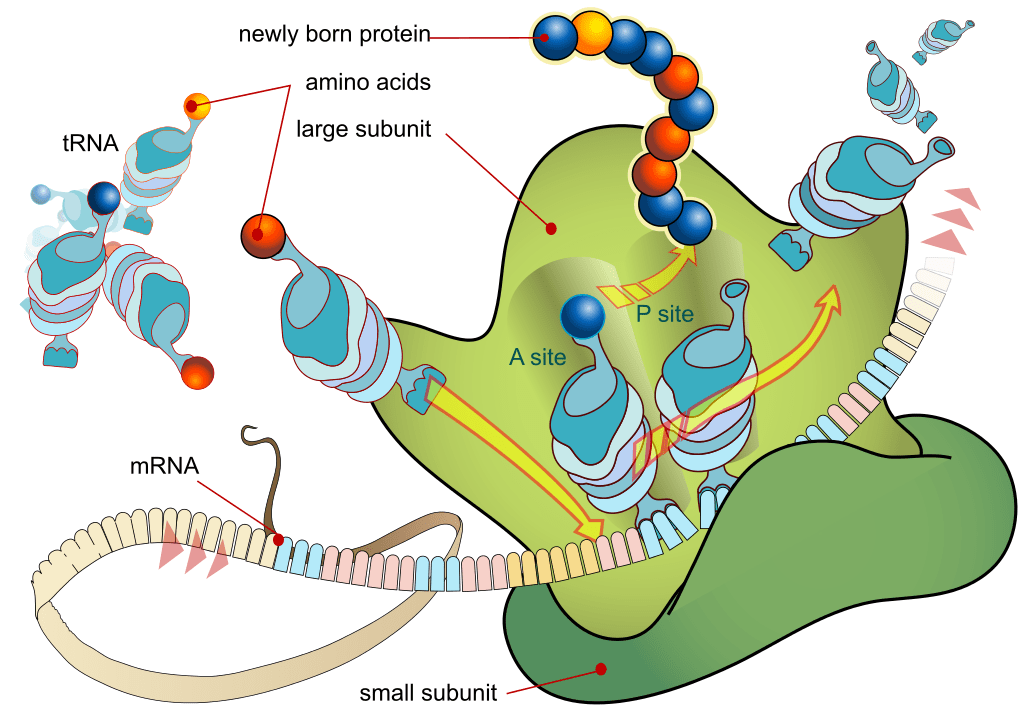
Once mRNA is present in cytoplasm, certain enzymatic reaction triggers amino acids to bind their complementary binding sites of their corresponding tRNAs.Stage 2
mRNA moves towards ribosomes in cytoplasm, binding to the smaller subunit of ribosomes.Stage 3
The tRNA bound with specific amino acids moves close to the mRNA template and binds to the larger subunit of ribosome, causing the formation of hydrogen bonds between the tRNA and mRNA.Stage 4
The next tRNA binds to the complementary binding sites on mRNA, so the two tRNA are holding the amino acids close to each other, until the peptide bonds are formed between the two amino acids. The enzyme responsible for this reaction is called peptidyl transferase. At each time, only two tRNA are bound to the large subunit of ribosome. (Three bases on each tRNA bind to three bases on mRNA.)Stage 5
After the peptide bond is formed, the tRNA moves out of the binding site of mRNA, leaving amino acids there.Stage 6
The other tRNA binds to the mRNA, repeating the same process. Therefore, the amino acid chain keeps growing in length.Stage 7
Polypeptide is now formed.


More Awesome Toppings